

Stainless-Clad Blind Flanges: A Smart Way to Reduce Costs Without Sacrificing Performance
When purchasing a large stainless steel blind flange, the price can sometimes become a significant part of the overall project cost. The larger the diameter and the higher the alloy content, the more dramatic the price difference can become.
Most engineers and purchasing departments automatically specify an all-stainless blind flange because corrosion resistance is required. Of coarse being a stainless supplier that’s our preference. However, in many applications, only one side of the flange is actually exposed to the process media.
If only the wetted surface requires corrosion protection, a stainless-clad blind flange may be a more economical solution.
What Is a Stainless-Clad Blind Flange?
A stainless-clad blind flange combines a carbon steel base with a layer of stainless steel bonded to the process side.
Instead of manufacturing the entire flange from solid stainless steel, only the surface that comes into contact with the product is stainless. The remainder of the flange is carbon steel, which provides the structural strength required for the application.
This design allows engineers to place the more expensive stainless material exactly where it’s needed while eliminating unnecessary material costs.
Actual Cost Comparison Between a Stainless-Clad Blind Flange and a Solid Stainless Steel Blind Flange
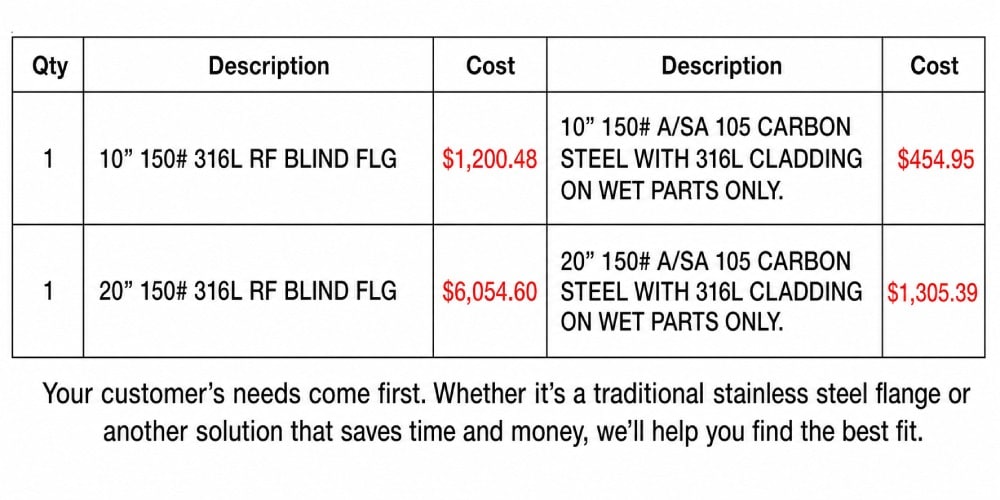
Where the Cost Savings Come From
Stainless steel contains costly alloying elements such as chromium, nickel, and molybdenum. As these raw material costs increase, the price of a solid stainless blind flange increases as well.
A stainless-clad blind flange uses significantly less stainless material while still providing corrosion resistance on the process side.
Potential cost savings may include:
- Reduced raw material costs
- Lower manufacturing costs
- Lower overall component costs
- Better budget control on large projects
The savings become even more noticeable as flange size increases. Large-diameter blind flanges require a substantial amount of material, making them one of the most expensive components in many piping systems.
Lower cost doesn’t necessarily mean lower performance.
When manufactured correctly and specified for the appropriate application, a stainless-clad flange can provide the corrosion resistance of stainless steel while maintaining the strength of carbon steel.
As with any component, several factors should always be evaluated before selecting a flange, including:
- Pressure class
- Temperature
- Corrosion environment
- Product compatibility
- Industry standards and specifications
For many industrial applications, a stainless-clad blind flange offers an opportunity to reduce costs while maintaining the performance required by the system.
Comments are closed